Aquatic Invasive Species
To help keep Blue Lake free of the species listed below, please:
- Inspect your boat, trailer and equipment and remove visible aquatic plants, animals and mud.
- Drain water from your boat, bilge, live wells and bait containers.
- Dispose of left over bait in the trash, not in the water or on land. Never move live fish, including minnows, from one body of water to another.
- Buy your minnows from licensed Wisconsin bait dealers or catch your own and use it to fish in the water you caught it from.
- Wash your boat and equipment with high pressure or hot water OR let it dry for 5 days before returning your boat to Blue Lake.
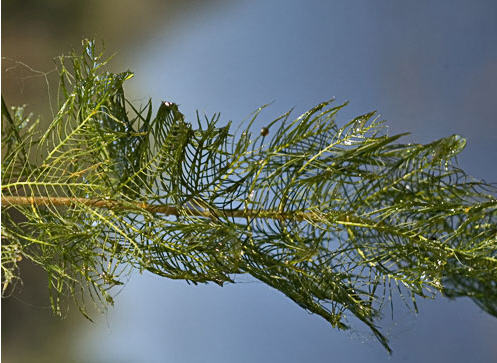
Eurasian Water-Milfoil This invader grows quickly in the Spring and forms a dense leaf canopy at the surface of the water shading out native aquatic plants. It spreads rapidly and is a nuisance to boaters and swimmers. You’ve surely spotted it if you’ve visited other lakes in the area including, Minocqua, Kawaguesaga, Tomahawk and many more. It is easily identified by its 1″-2″ dark green feathery leaves and reddish to dark green branching stems. Although many Blue Lake owners have been diligent in boating and fishing practices, we have not been able to avoid the spread of this plant. The presence of Eurasian Milfoil was confirmed near several boat landings in 2021. Mitigation began during the summer of 2021. You can read more about this here: Aquatic Plant Management Blue Lake HWM Removal Report #1 2021. Should you spot Eurasian Milfoil please report it immediately by email to bluelakeminocqua@gmail.com.
Zebra Musels These creatures filter plankton from the water as they feed, making the water clearer. Although this might sound good, it isn’t. Fish that are light sensitive may seek deeper waters to find shelter from the sun. As the sun penetrates deeper, aquatic plants can take root in more extensive areas than they did before zebra mussels moved into the area. Vegetation provides small fish with more places to hide and makes it more difficult for large predators to feed, resulting in stunted fish populations as well as posing significant problems for boaters.
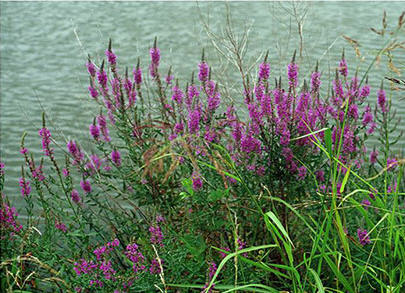
Purple Loosestrife This hardy perennial can outgrow native aquatic plants on which wildlife depend. Roots form a dense mat that blocks other plants. Eventually other vegetation is chocked out . In marshes where a loosestrife seed source is present, the plant can be expected to colonize exposed areas in high densities with great speed.
Aquatic Plant Survey
Blue Lake Aquatic Survey 2013-2014
Lake Management Plan
Blue Lake Management Plan 2011
Blue Lake Rapid Response Plan 2012
Special thanks to the following people who helped with the Blue Lake Mangagement Plan
Mark Bergeon, Matthew Bergeon, Tom Bose, Bill Clark, Teresa Colianni, Cindy Crochiere, John Gray, Cynthia Holmberg, Mark Holmberg, Ron Holmberg, Dick Johnson, Cheryl Kamba, Sylvia Knust, Margaret Krueger, Betty Myers, Dan Pagel, Sue Pagel, Bob Reed, Candy Simpson, Jane Wierschem, Ken Wierschem, Paul Garrison (DNR/UW-EXTENSION), Susan Knight (DNR/UW-EXTENSION), Sandy Wickman DNR/UW-EXTENSION)
 Blue Lake Preservation Association